 Amatle Institute
IFRS and SAM · South Africa
The standards, worked line by line.
Self-paced technical training on IFRS 18, IFRS 17, IFRS 15, IFRS 9 and SAM, taught in rand and in South African regulation. Every figure reconciles and every classification names the paragraph that drives it, so each answer traces straight back to the standard.
- Standards indexed
- 28IFRS, IAS and the Prudential Standards
- Paragraphs indexed
- 2,535every citation resolves to source
- Price
- R1,950a course, twelve months
- Worked in
- RandSouth African cases and rates
Courses
One standard, one course, one price.
R1,950 a course for twelve months, including every lesson added to that course and every revision made while a standard moves. Lesson counts are read from the catalogue, so what is shown is what is in the library today.
Before you buy
Watch a full lesson.
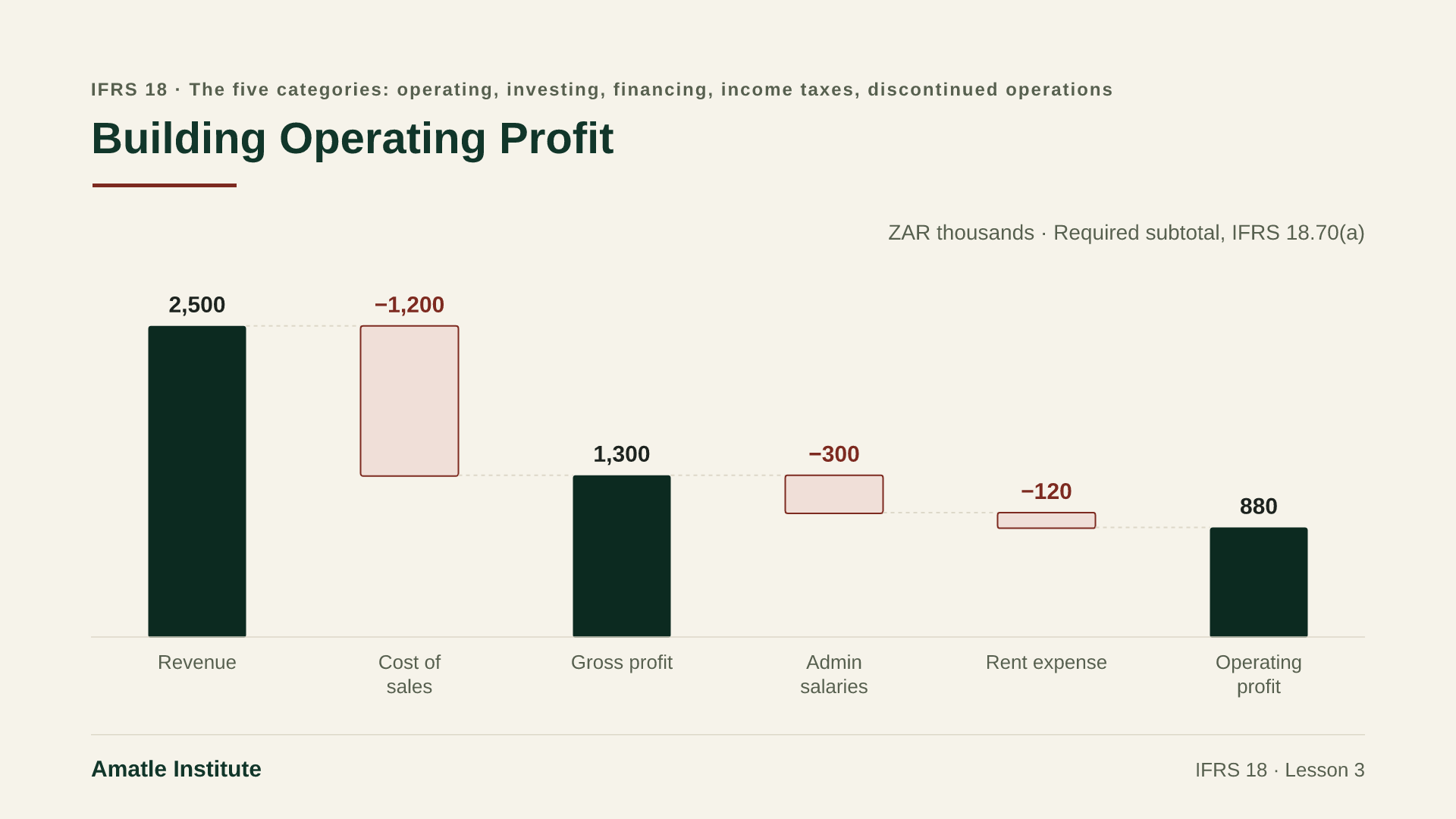
One complete lesson, free and without an account. Thirteen slides, narrated, building a full statement of profit or loss for a South African manufacturer under IFRS 18.
- Revenue of R2.5m worked down to profit for the period of R574,150
- Each of the five categories traced to its governing paragraph
- The test that decides whether interest income is investing or operating
- Companion article and the lesson glossary included
How to pay
Card, instant EFT or a bank transfer.
Whatever your firm's process needs. An invoice is issued on every purchase, addressed to you or to your employer.
Card and instant EFT
Access opens immediately
Card, instant EFT, Apple Pay and Google Pay through a South African payment provider. Your access opens the moment payment confirms and the invoice is emailed at the same time.
Bank transfer
For firms that pay by EFT
Choose bank transfer and you receive our banking details and a payment reference on screen, and a proforma invoice by email for your accounts department. Access opens when the payment reflects, usually the next business day, and your invoice follows.
Professional development
A record of what you completed.
Amatle Institute is not an accredited CPD provider and does not award CPD hours or points. What you receive is a certificate of completion naming the course, the content covered and the date.
Why that is usually enough
SAICA's policy since January 2020 is output-based, with no required number of hours or points and no requirement that learning comes from an accredited provider. Members record their own activities against a reflective plan and submit it only if selected for monitoring.
Check your own position
ASSA is phasing in an outputs-based system in place of the time-based one. Members still on the input-based route, holders of practising certificates and registered tax practitioners have separate obligations. Confirm with your body what it will accept before you rely on any course for compliance.
Questions
What people ask before enrolling.
How long do I have access?
Twelve months from purchase. That covers every lesson in the course, every lesson added to it during your year, and every revision made when the standard is amended. Standards move, so the course is maintained rather than frozen.
Which courses are complete?
Each course page lists every lesson in it, marks which are in the library today and gives the date for the rest. A course you cannot buy yet says so instead of showing a price.
Can I download the lessons?
No. Lessons, worked examples and companion articles stream from your library rather than downloading. Your certificate of completion is yours to keep.
Can my employer be invoiced?
Yes. Send us the firm's registered name and address through the contact form and we issue an invoice addressed to the firm, with a reference to quote. Access opens once payment reflects.
Is this exam preparation?
Not primarily. It is technical training for people applying the standards in practice. Students find it useful alongside their material, but it is not built to a syllabus and it does not replace one.